
Case Study - Transitional Vertebrae
Case Study: Identifying a Transitional Vertebra as the Root of Persistent Saddle-Related Pain
I was recently involved in a deeply insightful case with a friend and her exceptionally kind gelding. He is a horse who had been struggling for some time despite diligent care. He had become increasingly reluctant to canter and resistant to bending under saddle. Although he was ridden in a custom-made saddle that had been professionally refitted only weeks earlier, he still appeared uncomfortable. The saddle consistently slipped to one side and pressed into his lumbar region, raising immediate concerns.
My friend reached out because she was worried about his wellbeing. This horse carried a long history of lumbar, sacroiliac, and hock discomfort. She had explored an extensive range of interventions—joint injections, supportive supplements, regular bodywork, acupuncture, nutritional adjustments, and farriery—yet the underlying issue persisted. Her frustration was understandable; despite her commitment, her horse remained in pain.
Using the SaddleFit 4 Life® mapping system and a comprehensive 80-point saddle evaluation, I assessed saddle fit for both horse and rider. During this process, we uncovered a critical and previously overlooked detail: the horse had a transitional vertebra on the left side.
In past assessments, saddle fitters—including myself—had palpated what we believed to be the last rib and followed it up to the longissimus muscle to determine the saddle support area. However, the rib we had been identifying was actually the transitional rib, not the true final rib. This misinterpretation had led to an inaccurate understanding of where the saddle should sit.
Once we recognised the anomaly, I palpated again—first locating the end of the transitional rib, then identifying the actual last rib. The discovery significantly shortened the horse’s true saddle support area. For the owner, this revelation was both validating and emotional; after years of searching, she finally had an explanation for her horse’s persistent discomfort.
With this new information, we made the necessary adjustments to the saddle setup. The transformation was immediate. Horse and rider were finally aligned over the strongest, most stable part of his back, and he was able to work comfortably and without pain.
This experience was a powerful reminder of how subtle anatomical variations, such as transitional vertebrae, can profoundly influence saddle fit and equine performance.

What Transitional Vertebrae Are
Transitional vertebrae are hybrid vertebrae that appear where one spinal region blends into the next. They show mixed characteristics of both regions—part thoracic, part lumbar, for example. This blending can produce lumbar ribs, which are essentially rib-like projections attached to the first lumbar vertebra. These structures are not typical, but they’re not rare either.
Transitional vertebrae can occur anywhere the spine changes type, but the thoracolumbar junction, where the last thoracic vertebra meets the first lumbar, is a particularly common site. There is a wealth of information on this website -> The Horse's Back.
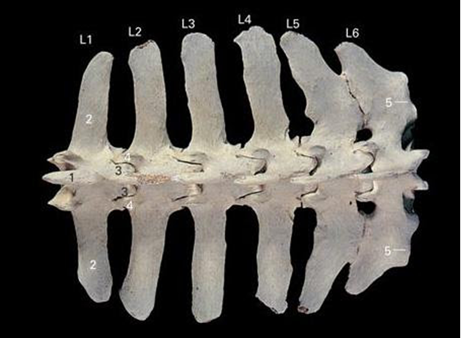

Normal Lumbar Transitional Lumbar Transverse Transverse Processes Process (L1 – left side)
Why Transitional Lumbar Ribs Matter in Ridden Horses
While many horses with transitional vertebrae remain sound and functional, these variations can influence the way a horse moves and responds to ridden work. The thoracolumbar junction is a major biomechanical hinge, responsible for:
Flexion and extension
Lateral bending
Force transfer between forehand and hindquarters
When the vertebrae in this region are atypical, the horse may compensate in ways that affect performance, comfort, and long-term soundness.
Potential Effects
Altered spinal mobility: Transitional vertebrae may reduce flexibility or create uneven movement patterns.
Saddle fit challenges: The shape of the back can be subtly different, making pressure points more likely.
Secondary musculoskeletal issues: Compensatory patterns can lead to scoliosis, spinal arthritis, or soft-tissue strain.
Straightness and engagement problems: Horses may struggle to bend evenly or step under with one hind leg.
Hoof asymmetry: Long-term compensation can show up in the feet, especially in the hind limbs.
How Transitional Vertebrae Are Identified
Most transitional vertebrae are not detected during routine exams. They’re often found incidentally on radiographs or post-mortem. Because the structures are internal and subtle, palpation alone rarely reveals them.
To assess the area when back pain or performance issues arise Veterinarians may use:
Radiography
Scintigraphy
Ultrasound
Management Considerations for Ridden Horses
A horse with transitional lumbar ribs isn’t automatically compromised. Many perform at high levels with thoughtful management. The key is understanding how the variation affects the individual horse.
Supportive Strategies
Saddle fitting with extra care: Custom panel length helps distribute pressure more evenly and avoids negative reflex points.
Targeted physiotherapy: Mobilization, stretching, and strengthening exercises can improve comfort and symmetry.
Core and topline conditioning: Work that encourages lifting through the thoracolumbar region is especially helpful.
Regular veterinary assessment: Monitoring for early signs of discomfort or compensation helps prevent chronic issues.
Hoof balance management: Farriery may need to address asymmetries linked to spinal compensation.
Why This Topic Deserves More Attention
Transitional vertebrae are underdiagnosed and under-discussed, despite their potential to influence biomechanics and welfare. As awareness grows, more riders and professionals are recognizing that subtle anatomical variations can have meaningful effects on performance and comfort.
Understanding these structures empowers you to make better decisions about training, saddle fit, and long-term care—ultimately supporting a healthier, happier horse.
If you’d like to explore how transitional vertebrae affect specific disciplines I’d be glad to dive deeper.


Comments